I'm going to have to try this next spring...
Sunday, 13 July 2014

Got the Can't Eat Food Blues...
So, it looks like I'm going pretty much paleo, with some 'cheating' with the occasional bit of refined sugar.
At this juncture, the list of what I can't eat is getting as long as the list of what I can- no tomatoes, or acidic foods (including apple cider vinegar, lemons, oranges, and cut fruit dipped in ascorbic acid to keep it fresher on the shelf- discovered that when a package of pre-cut fruit from Sobeys stripped a layer of skin off the inside of my mouth), dairy (including goat... I tried... nope), all grains (but I can cheat with a couple of the gluten free varieties as long as I don't binge or do it too often), and I can eat a bit of potato as long as I don't eat it too often or in large quantities (sharing a large NY Fries every couple of months doesn't seem to harm me in any way).
*sigh*
There goes my home made cheese and yoghurt-making. I already had to give up making my own bread a few years back.
Not cool, body. Not cool.
At this juncture, the list of what I can't eat is getting as long as the list of what I can- no tomatoes, or acidic foods (including apple cider vinegar, lemons, oranges, and cut fruit dipped in ascorbic acid to keep it fresher on the shelf- discovered that when a package of pre-cut fruit from Sobeys stripped a layer of skin off the inside of my mouth), dairy (including goat... I tried... nope), all grains (but I can cheat with a couple of the gluten free varieties as long as I don't binge or do it too often), and I can eat a bit of potato as long as I don't eat it too often or in large quantities (sharing a large NY Fries every couple of months doesn't seem to harm me in any way).
*sigh*
There goes my home made cheese and yoghurt-making. I already had to give up making my own bread a few years back.
Not cool, body. Not cool.
Thursday, 19 June 2014
Radical Roots to the Roots of Oppression- How the carrot became symbolic of religious hegemony
In the 16th the Low Countries (corresponding
roughly to the modern day countries of Belgium, the Netherlands and Luxembourg)
were struggling to become a country of their own, and win freedom of religion.
Calvinism had begun to spread, and Charles V, the King of Spain, who owned the
title to the lands, called down the Inquisition on the region to try and halt
the spread of the ‘heresy’. Most cities in the Low Countries were governed by
guilds and councils, which elected a ruler, known as the ‘Steward’ or ‘Stadtholder’.
Many provinces would elect one person to be their Steward jointly, but the
position was not initially hereditary. Charles’s son, Philip II, tried to centralize
the government of the region, which was opposed as well. In 1566 he had to send
the Duke of Alva into the region to put down rebellion in the country. The
United Provinces of the Low Countries elected Prince William of Orange as their
leader, and thus began the 40 Years War. He was assassinated in 1584, and his
second son, Maurice, took over the fight. He was 17 at the time.
England came to the aid of the Low Countries, and then
France. By 1609 a truce had been established. In 1648 the Republic of the Seven
United Netherlands was recognized as their own country as part of the Treaty of
Westphalia. The Dutch struggle for independence had lasted eighty years.
In a northern city called Hoorn, in the Netherlands, they
found a subtle way of protesting the interference from the Kings of Spain... by
growing carrots. Orange carrots. Only orange carrots. This protest ‘took root’
and spread all over the region, but so subtly that there isn’t any record
stating explicitly why. Everywhere else people were growing yellow, red, white
and purple varieties as well. The 'Horn' variety of carrots comes from there.
So, why did orange become the only colour for carrots in the
modern, Western world?
The Reformed Church (a version of Calvinist Protestantism)
became the de-facto church in the new Republic. Catholicism was banned, or at
least taxed heavily, depending on the different policies of the individual provinces.
In 1654 England went to war with the Republic of the Seven
United Netherlands over trade, only six years after they helped to ratify the
agreement that established the country. England still had reduced trade with
Spain, while the Republic, ever-pragmatic, started up full trade relations with
Spain. Plus, the English had just suffered through a bitter civil war, and
every facet of life in that country had been disrupted. The Republic lost the
First Anglo-Dutch War, and as part of the negotiations, Oliver Cromwell, the
Lord Protector of England, had a secret annexe put on the treaty which forbade
the Republic from ever electing a representative of the House of Orange to the
position of Stadtholder ever again.
First William, then his sons Maurice and Frederick Henry,
and then William II and his son William III of the house of Orange, were seen
as defenders and upholders of Protestantism. All of them were extremely competent generals
and statesmen as well.
After what the Dutch call the ‘Year of Disaster’, 1672, when
Louis XIV invaded the Republic and forced them to cede land, the collective
provinces decided that the treaty they had signed with Oliver Cromwell was
defunct as he wasn’t around to enforce it anymore. They elected William III as Stadtholder, who
had already made himself King of England, Scotland and Ireland through marriage
to Mary II (the daughter of James II, king of England, and his first cousin on
his mother’s side), a shrewd military mind (see The Battle of the Boyne), and
some deft political negotiations (the Glorious Revolution of 1688).
What this meant was that Protestantism remained the dominant
form of Christianity in all of these countries, and the Republic remained free
to conduct trade throughout Europe and all of the colonies. The House of Orange
was at the head of the richest and most powerful trading and military empire in
Europe.
Religious factions remained bitterly opposed in England, and
in Ireland, the northern part of the island had just been recently entirely
depopulated of Catholics (by killing, selling into slavery, and those who saw
it coming running away) and then re-populated with the ‘troublesome’ Border
Scots, who happened to be extremely Protestant. Also, in Ireland, most of the
land was owned by Protestant lords, both in the North and South. In England,
Catholics were denied the right to vote and sit in the Wesminister Parliament,
and they could not hold commissions in the army for over a century. The ban on
the British Monarch from being a Catholic or marrying one was only repealed in
2013.
In Northern Ireland, the ‘Orange Order’ continues to this
day as a Protestant fraternal organization, which once had branches all over
North America. It’s not as popular in these times, when Protestant and Catholic
aren’t at each other’s throats as much anymore, at least, outside of Ireland.
Humans are well-known to engage in symbolic eating, whether
consciously or subconsciously. In the Netherlands the orange carrot remained a
symbol well into the late 18th Century, when it was against the law
to display the roots at market ‘too prominently’, as it was a symbolic gesture
of support for the monarchy… The House of Orange.
Everywhere else, the Horn carrot and its progeny were sweet, of good quality, and a very homogenous colour, even if the symbolic origins were forgotten over time. And Dutch farming was synonymous with quality products.
Wednesday, 13 November 2013
Making yoghurt the right way, or, don't do what I did
So, I bought a yoghurt-maker. It cost $45. The product was inedible and acidic, and I gave it to my neighbours after only three uses. Complete waste of time and money, and I felt like a dope afterwards.
Don't do what I did.
You can make yoghurt with stuff you already have in the house (for tools- although you might want some butter muslin if you want to drain the whey from your yoghurt, which makes it more lactose-intolerant-friendly), and you can re-use the same batch a couple of times, but make sure you get a new starter culture every couple of batches for optimal flavour.
Here are some good online instructions-
New England Cheesemaking Company- Yoghurt info page
Make yoghurt in your oven
There's a lot more to it than was covered in the info booklet that came from the yoghurt-making-machine. Which I had to download and print because the company was too cheap to include it.
That thing about hindsight is so true.
Tuesday, 12 November 2013
Battening down the hatches
It went down to -6 C last night... Winter arriveth. (Yes, I know I made that word up, but it does follow the rules for Old English ;)
This winter I'm going to make sure that all the windows have proper, heavy-duty curtains on them. I got a pair of blackout curtains from Canadian Tire (on sale, woot!) this past summer, and they made a world of difference keeping out the heat. I'm also noticing that they trap the cold air nicely against the glass. I get the feeling that if I put them in the basement (walkout basement with acres of glass thanks to a passive solar design) that it will make the temperature much more habitable down there this year. Things might heat up okay during the day, but at night it's downright cold. Also, it's time for the yearly trip to the hardware store for large plastic sheets packaged up as 'winterizing kits', and attaching them to my big windows. It's a bit of a job, but it works great.
This year I'm buying myself an electric heater that looks like a small wood stove. Since I'm never going to get a real one, I guess I can use my imagination and pretend... There's only so many wool socks you can put on and still fit inside your shearling slippers, and fingerless gloves are nice and all, but they're hard to type in and my fingers *still* get cold.
That basement room is going to be comfy, darn it. I'm tired of freezing my buns off.
This winter I'm going to make sure that all the windows have proper, heavy-duty curtains on them. I got a pair of blackout curtains from Canadian Tire (on sale, woot!) this past summer, and they made a world of difference keeping out the heat. I'm also noticing that they trap the cold air nicely against the glass. I get the feeling that if I put them in the basement (walkout basement with acres of glass thanks to a passive solar design) that it will make the temperature much more habitable down there this year. Things might heat up okay during the day, but at night it's downright cold. Also, it's time for the yearly trip to the hardware store for large plastic sheets packaged up as 'winterizing kits', and attaching them to my big windows. It's a bit of a job, but it works great.
This year I'm buying myself an electric heater that looks like a small wood stove. Since I'm never going to get a real one, I guess I can use my imagination and pretend... There's only so many wool socks you can put on and still fit inside your shearling slippers, and fingerless gloves are nice and all, but they're hard to type in and my fingers *still* get cold.
That basement room is going to be comfy, darn it. I'm tired of freezing my buns off.
Friday, 25 October 2013
Ban single use plastic...
This is a great video I just saw on Upworthy:
Sharing around to help raise awareness...
Sharing around to help raise awareness...
Some local food places in my area
There are some fun places to visit in the area around where I live. I'm going to miss being able to go to most of them when winter hits.
http://www.stjacobs.com/farmers-market
This is where I go to buy most of my food through the majority of the year. There are some things you can't get there, like yoghurt, but the quality of meat, cheese and veggies makes up for that. Also, there's a bulk food stall (which won't be back until the burnt-down building is rebuilt in a couple months) that has pretty darn good prices, and a particularly finely-ground almond flour that is good in baking.
http://www.martinsapples.com/retail/retail-home-page
This family-run orchard is almost within walking distance of me. They have a well-stocked store that also offers some other things than apples.
http://www.lyndonfishhatcheries.com/publicfishing.html
I went to Lyndon Fisheries with my dad a few weeks ago, and it was a nice afternoon. It is definitely a great place to take young kids to learn how to fish. The taste of the fish, however, was kinda not so nice- really fatty, and there was just something not tasty about it. It might be fun to host an event there sometime, though.
http://www.herrles.com/
Herrles is a farm-stand store that is open seasonally and offers local produce. They're closed now for the season.
http://www.naumanfarm.com/
Nauman's has pumpkins. Lots 'n lots of pumpkins. Plus, a corn maze. I go there to pick strawberries and raspberries in the summer. Nice folks.
http://www.localharvest.ca/
*THE* place to find local farms and food in our region. The mapping feature is particularly helpful.
http://www.stjacobs.com/farmers-market
This is where I go to buy most of my food through the majority of the year. There are some things you can't get there, like yoghurt, but the quality of meat, cheese and veggies makes up for that. Also, there's a bulk food stall (which won't be back until the burnt-down building is rebuilt in a couple months) that has pretty darn good prices, and a particularly finely-ground almond flour that is good in baking.
http://www.martinsapples.com/retail/retail-home-page
This family-run orchard is almost within walking distance of me. They have a well-stocked store that also offers some other things than apples.
http://www.lyndonfishhatcheries.com/publicfishing.html
I went to Lyndon Fisheries with my dad a few weeks ago, and it was a nice afternoon. It is definitely a great place to take young kids to learn how to fish. The taste of the fish, however, was kinda not so nice- really fatty, and there was just something not tasty about it. It might be fun to host an event there sometime, though.
http://www.herrles.com/
Herrles is a farm-stand store that is open seasonally and offers local produce. They're closed now for the season.
http://www.naumanfarm.com/
Nauman's has pumpkins. Lots 'n lots of pumpkins. Plus, a corn maze. I go there to pick strawberries and raspberries in the summer. Nice folks.
http://www.localharvest.ca/
*THE* place to find local farms and food in our region. The mapping feature is particularly helpful.
Saturday, 12 October 2013
More experiments with cheese
I need to go to the farmer's market today and pick up some beeswax. I have a 'Farmstead cheese' ripening and drying on my counter right now, wrapped up in clean cheese cloth, and it needs to be waxed and then stored in my fridge. I hope it tastes okay in four months... It's a bit of a gamble. But, it smells quite nice right now, so I hope everything goes well.
Here are some links for more info if you're interested-
Dr.A.R. Hill, Dept. of Food Science, University of Guelph
A couple of Canadian companies that sell supplies-
http://www.makecheese.ca/
http://glengarrycheesemaking.on.ca/
And one American one (which has an awesome recipe section and a monthly newsletter)-
New England Cheesemaking Supply Co.
And if you go completely insane about cheese and want to learn more...
Cheesemaking Technology course, University of Guelph
There are also weekend 'artisinal' cheesemaking workshops offered all over the place. You can use Google to find more on that topic.
Here are some links for more info if you're interested-
Dr.A.R. Hill, Dept. of Food Science, University of Guelph
A couple of Canadian companies that sell supplies-
http://www.makecheese.ca/
http://glengarrycheesemaking.on.ca/
And one American one (which has an awesome recipe section and a monthly newsletter)-
New England Cheesemaking Supply Co.
And if you go completely insane about cheese and want to learn more...
Cheesemaking Technology course, University of Guelph
There are also weekend 'artisinal' cheesemaking workshops offered all over the place. You can use Google to find more on that topic.
Monday, 7 October 2013
Passing along some of the goodies from my course
How to get the best soil for your garden...

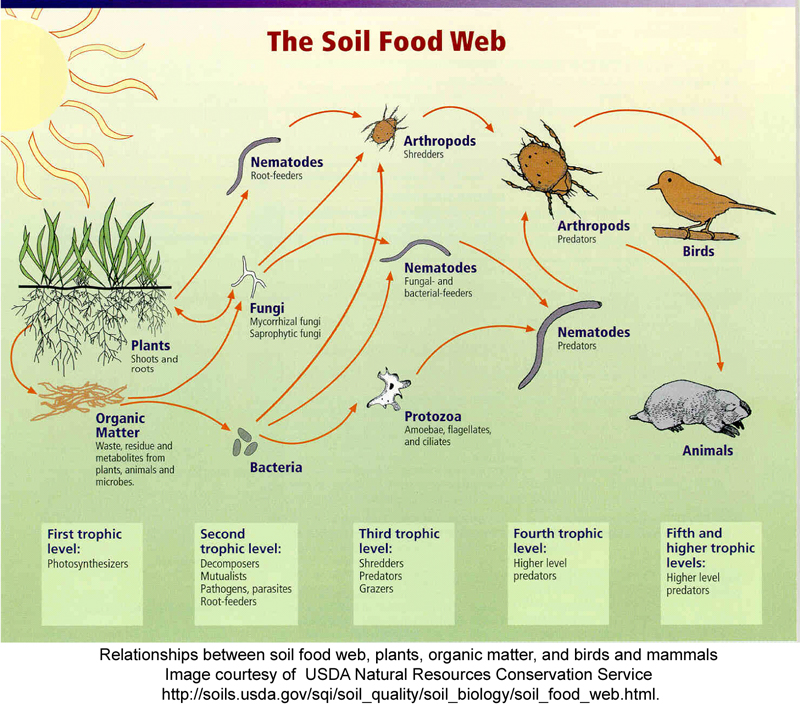
The Soil Food Web
Plants have existed on the earth for at least a billion
years. During that time different plants and organisms found ways of working
together in mutually-beneficial ways.
Different organisms work together in your garden to
create healthy soil- bacteria, fungi, protozoa, nematodes, microarthropods, and
larger organisms. These organisms work together to support the healthy growth
of plants by suppressing disease, retaining nutrients in the soil and drawing
them in to make them available for roots, decomposing waste materials, and
conditioning the soil so that roots can grow down to the depth they need.
Plants use photosynthesis to recycle carbon dioxide (CO2)
into sugars. These sugars are then used to increase the size of the plant, or
are bonded to other nutrients (such as phosphorus, sulfur, magnesium, calcium,
etc.) to transport them to where they need to go inside the plant. These
nutrients are found in the soil, and scientists have found that more than 48
are essential to growing plants.
If you believe the fertilizer companies, then apparently
you only need three- nitrogen, phosphorus, and potassium, the NPK you see on
the bag.
Nope. You need a lot more than that.
However, if you have the right balance of organisms they
do all the work of converting the pebbles, sand, clay and organic matter into
all the minerals your plants need to grow. The rest is supplied by air, water
and sunlight. The nice thing about that is that the plants and organisms will
work together and provide for themselves. Humans don’t need to do anything more
than provide the best environment for them to thrive.
If you use chemicals to kill off insects or weeds it will
also kill off your useful organisms as well, and then you need to spend even
more money to put more chemicals on your soil to keep up the fertility. This is
good for the chemical companies, but not as good for you (or your soil).
Use Compost to Inoculate Against Bad Bugs
Compost comes already full of bacteria and fungi, they
were the organisms that turned your food into dirt. If you keep your compost
pile aerated (not compacted so air can get in), just moist enough but not wet,
and give it enough time to kill off weed seeds and plant pathogens, then you
have the perfect booster mix to stimulate good growth in your garden.
Keeping air in the mix means that aerobic bacteria (those
that live in environments with air) will be the dominant form in your compost.
This is good, because they fix nitrogen into the soil for your plants to use
later. If the compost pile is too wet or compacted, then anaerobic bacteria (that
don’t use air) will grow, and they use nitrogen and make it into an ammonia
gas, which then leaches out into the air. Not so useful for your garden, and
stinky, too. Also, anaerobic bacteria didn’t evolve to work in soil with
plants, so their presence in your garden can keep fertility levels down for a
while until they dissipate.
If your compost is smelly and black, then putting it into
your garden will harm it in the short term instead of helping.
However, if, whenever you do significant tilling
(digging, turning the soil over) you also add compost, then it will repair any
damage to the natural organisms in your soil, and replace them with new ones.
So, how do plants use these bacteria and fungi? They
squirt out sugars, proteins and carbohydrates into the soil (basically, they
make cookies), to attract the particular types that they need to the area on
and around their roots. These bacteria and fungi excrete (yes, poop) out
nutrients, and then they, themselves, become prey for the larger predators
(protozoa and nematodes), and also the insects which prey on them, which adds
more nutrients from the remains. The larger predators eat basically everything,
which reduces the ability of harmful bacteria, fungi and insects to get near
your plants to feed on them. They get out-performed and eaten.
A study by the Center for Microbial Ecology at Michigan
State University showed that in one acre of woodlot soil in Michigan there were
one million different species of bacteria, five hundred thousand species of
fungi, thousands of kinds of protozoa, and hundreds of species of nematodes.
If your garden can get that prolific then you’re doing
very, very well. Good quality compost can help you get as close as possible.
If you see water puddling on your soil after a rain, it
means that there isn’t enough organic matter and air in your soil, and optimal
organism growth isn’t possible. Add more compost and composted manure, and…
Voila!
Friday, 4 October 2013
Wow. September was harder than I thought it would be...
But, in the meantime, I've started the Urban Agriculture/Horticulture Certificate through the University of Guelph. My freak-out was (as is usually the case) completely unnecessary. I'm enjoying doing the readings, and learning quite a lot in the process.
I've volunteered to be in charge of my co-op's community garden, and I'm looking forward to running some seminars this fall and winter. Some of the ideas I've come up with were 'what to do with your garden in the fall- what you can plant and how to prepare it for the spring', plus some general information ones like 'composting basics' and 'beneficial insects'. I was also thinking about doing a craft for building an Insect Hotel. It would need to be this fall before the snow hits the ground. We could do a nature walk to collect items. (I'm talking myself into this, now, and it's getting more and more exciting).
One other thing to pass along- this nifty list of 23 Smartphone Apps which will help you figure out everything from when to water your garden, to inventorying your food by best before dates, and finding what's in season in your area.
Hey folks... we made it into Fall. Time to start thinking about wool socks and cocooning with garden catalogs again.
I've volunteered to be in charge of my co-op's community garden, and I'm looking forward to running some seminars this fall and winter. Some of the ideas I've come up with were 'what to do with your garden in the fall- what you can plant and how to prepare it for the spring', plus some general information ones like 'composting basics' and 'beneficial insects'. I was also thinking about doing a craft for building an Insect Hotel. It would need to be this fall before the snow hits the ground. We could do a nature walk to collect items. (I'm talking myself into this, now, and it's getting more and more exciting).
One other thing to pass along- this nifty list of 23 Smartphone Apps which will help you figure out everything from when to water your garden, to inventorying your food by best before dates, and finding what's in season in your area.
Hey folks... we made it into Fall. Time to start thinking about wool socks and cocooning with garden catalogs again.
Wednesday, 4 September 2013
Now is the time to start thinking about spring
In the garden, that is. Harvests have peaked, and will continue to trickle onwards a bit for the next month. Then comes cleanup, setup, and planting those things which can overwinter.
I just found the best wiki ever- Practical Plants
You can set search parameters by hardiness zone, soil type, amount of sun received, and more. Then, you hit 'go' and find the plant that fits what you needs. There's a list at the bottom of the page, organized by uses (such as adhesives, poultices, jam, soap, paper, paint, etc). The list is extensive.
Also, starting now you can do soil tests, soil amendments, and set up raised beds. I'm thinking about ordering some soil test packages just for interest's sake. I'd like to know the NPK (nitrogen, phosphate and potassium) levels in my backyard and veggie garden.
I just found the best wiki ever- Practical Plants
You can set search parameters by hardiness zone, soil type, amount of sun received, and more. Then, you hit 'go' and find the plant that fits what you needs. There's a list at the bottom of the page, organized by uses (such as adhesives, poultices, jam, soap, paper, paint, etc). The list is extensive.
Also, starting now you can do soil tests, soil amendments, and set up raised beds. I'm thinking about ordering some soil test packages just for interest's sake. I'd like to know the NPK (nitrogen, phosphate and potassium) levels in my backyard and veggie garden.
Monday, 2 September 2013
My local farmer's market just had a major fire
Thank goodness the whole place didn't burn down, but the main building, where I did a lot of my grocery shopping, is now nothing but a huge pile of soggy ash.
 Thankfully, Charles Quality Meats has a stall at the Kitchener Market as well on Saturdays. It's not as convenient, but I've been wanting to check it out anyways, I guess. Not a happy reason to be doing so, though. I wonder if they do a farm gate type of sales as well?
I was half-considering setting up a stall at the St. Jacob's Market myself. Looks like that will be put off until next Spring at least.
I was half-considering setting up a stall at the St. Jacob's Market myself. Looks like that will be put off until next Spring at least.
Sunday, 1 September 2013
Home made cheese
I have to share this fabulous resource with you- The New England Cheesemaking Supply Company. I saw this DIY intro to cheese kit at my local foodie independent grocery store, Vincenzo's, sometime last year, but I couldn't convince myself to buy it. The price tag of $30 was a bit steep, it seemed to me. But, the thought lingered. I had tried making cheese a few years previously using instructions off the Internet, but the operation failed, and I couldn't figure out why. I asked a few people I knew who liked to cook, but none of their suggestions seemed helpful. So, it remained an unexplained failure.
The local grocery store has a little café, and my husband and I have taken to going there, as their coffee is respectable, their pastries are excellent (so I hear from him), and they have other selections of things I can eat which won't half kill me. One of those treats is cheese. So, a couple weeks ago on one of our visits, I wandered over to the exotic cheese cooler. Applewood smoked cheddar rolled in paprika from England, brie from France, a few things from Scandinavian countries, plus some good home-grown products as well. As I was deciding on which little slice of creamy calories to buy my eyes were drawn to the shelf to the right of the cooler. There sat three or four of those cheesemaking kits that I had seen before. On an impulse I picked one up. It just fit into my Bag of Holding (aka. purse satchel), and I had a little bit of spare cash as my first full EI cheque of the summer had come in.
I bought it. Chris rolled his eyes.
I opened up the package, read the booklet. One of the things that I saw in the instructions was that white vinegar was used in one of the steps. I can't use white vinegar in anything, including the dishwasher, as I'm so extremely sensitive to grains that it makes me sick. Cider vinegar is my only option. I asked around on Facebook on the various medieval re-enactment cooking groups that I belong to, and the opinion came back that it would be an acceptable substitute. I knew from canning that they have the same pH balance. It also made me wonder about commercial cheeses, and if I had been mildly poisoning myself. All the more reason to try making it for myself. Now I had incentive, and then the box proceeded to sit on my kitchen counter for a couple weeks as I got up the courage to try it.
My dad, in support of my cheesemaking efforts brought along a bag of 2% milk and a 1L carton of half and half cream (which also languished in the fridge for a couple weeks, until Chris ran out of his regular milk and started to use that up). He couldn't find the regular homogenized for some reason, but I figured it would be okay. The milk hadn't been ultra-pasteurized (UT) or ultra-high-temperature pasteurized (UHT) like you see in the sterile, shelf-stable cartons.
It wasn't until I was back at work in the school library in the last week of August that I finally decided to go for it. However, I was also home for a couple days because I'd had a molar extracted. Go back to work for a couple days, then take off again to have your face messed with... and stay home with an ice pack and T3 feeling sorry for yourself. I was feeling sorry for myself, so I decided to try making cheese. It might have been the codeine talking. I decided to try feta.
I *know* it was the codeine's fault that I mis-read the directions. Instead of dissolving the rennet tablet in 1/4c water, I got it confused with the 2c for the light brine soaking solution. There were no curds. In fact, it looked just like my last attempt. Tiny little blobs bobbed in a pure-white mixture. I dumped it down the sink, rinsed the pot and utensils, and went and sat on the couch with an ice pack for a bit. I read the directions again, and saw my mistake.
Fine. I'd messed up one batch. This time I was going to make it right. And it was going to work, dammit.
When I had the energy and the hole in my jaw wasn't bugging me so much, I made a trip to the health food grocery store on Bridgeport. Healthy Foods and More. I like the people there. The owners are kind, their employees are funny and helpful, and they have a lot of stuff that I need. Some of the prices even rival the prices I can get through my co-op food buying group from the Ontario Natural Food Co-op. Not all of them, obviously. Some stuff is super-expensive, but if you're canny it can work out. Plus, they have baked goods that my daughter can eat, and a flour-less brownie made with black beans (and lots of sweetener). One of those, and a big can of coconut water is my occasional Friday treat. After one of those I don't often need supper.
Anyways. I found some milk that was on sale, two 1L bottles of organic goat's milk, and two 1L bottles of Guernsey cow milk. I tried the goat's milk first, as it's apparently great for feta.
The nice thing about this recipe is that you don't even need to turn on the stove to make this cheese. Hot water, a clean pot, clean kitchen sink, and the dairy thermometer that came in the kit are all you need to keep it at the right temperature.
I followed the instructions. I made cheese. I cut it into blocks. Raw, it tasted pretty darn good, but it needed to soak for 10-12 hours in a saturated brine solution. That next morning I looked upon my cheese, and it was good. I saw my neighbour walking her three dogs, and ran out to her with the cheese for a first taste-test, wearing my bathrobe with nothing under it, and bare feet. She was pleased to try the first fruits with me.
It was like eating a cheese-textured salt lick.
I thought I had failed yet again. I almost threw it out. One last desperate read through the instructions, and it said that the cheese had to rest at room temperature for a couple days. I gave it one last go, and put the cheese blocks in a plastic container and popped one corner up so it could breathe but would keep out flies (and cats- hopefully).
The next morning it tasted much better, but still too salty. I'm not the biggest fan of salt, so I soaked the cheese in some water to try and leach out some of it. It worked. The cheese was a little squeaky, but the amount of salt left in it was just enough to flavour without taking your tongue off. I shared some with my next-door neighbours, and ate about half of it myself. I figured I was due, since I still couldn't eat solid foods after my tooth came out.
It tastes great with cucumber, and I'm sure it would make an excellent cucumber, tomato and fennel salad.
What I didn't realize when I bought it is that if you follow the directions carefully, you can have about 10lbs (or 4.5kg in metric) of cheese. So, for $2.50 (the average price per packet of starter culture from the kit)+ milk = $8.50 for 1 lb/.45kg of organic goat's milk feta... That's not bad. If I didn't want to go organic it would be even cheaper.
The local grocery store has a little café, and my husband and I have taken to going there, as their coffee is respectable, their pastries are excellent (so I hear from him), and they have other selections of things I can eat which won't half kill me. One of those treats is cheese. So, a couple weeks ago on one of our visits, I wandered over to the exotic cheese cooler. Applewood smoked cheddar rolled in paprika from England, brie from France, a few things from Scandinavian countries, plus some good home-grown products as well. As I was deciding on which little slice of creamy calories to buy my eyes were drawn to the shelf to the right of the cooler. There sat three or four of those cheesemaking kits that I had seen before. On an impulse I picked one up. It just fit into my Bag of Holding (aka. purse satchel), and I had a little bit of spare cash as my first full EI cheque of the summer had come in.
I bought it. Chris rolled his eyes.
I opened up the package, read the booklet. One of the things that I saw in the instructions was that white vinegar was used in one of the steps. I can't use white vinegar in anything, including the dishwasher, as I'm so extremely sensitive to grains that it makes me sick. Cider vinegar is my only option. I asked around on Facebook on the various medieval re-enactment cooking groups that I belong to, and the opinion came back that it would be an acceptable substitute. I knew from canning that they have the same pH balance. It also made me wonder about commercial cheeses, and if I had been mildly poisoning myself. All the more reason to try making it for myself. Now I had incentive, and then the box proceeded to sit on my kitchen counter for a couple weeks as I got up the courage to try it.
My dad, in support of my cheesemaking efforts brought along a bag of 2% milk and a 1L carton of half and half cream (which also languished in the fridge for a couple weeks, until Chris ran out of his regular milk and started to use that up). He couldn't find the regular homogenized for some reason, but I figured it would be okay. The milk hadn't been ultra-pasteurized (UT) or ultra-high-temperature pasteurized (UHT) like you see in the sterile, shelf-stable cartons.
It wasn't until I was back at work in the school library in the last week of August that I finally decided to go for it. However, I was also home for a couple days because I'd had a molar extracted. Go back to work for a couple days, then take off again to have your face messed with... and stay home with an ice pack and T3 feeling sorry for yourself. I was feeling sorry for myself, so I decided to try making cheese. It might have been the codeine talking. I decided to try feta.
I *know* it was the codeine's fault that I mis-read the directions. Instead of dissolving the rennet tablet in 1/4c water, I got it confused with the 2c for the light brine soaking solution. There were no curds. In fact, it looked just like my last attempt. Tiny little blobs bobbed in a pure-white mixture. I dumped it down the sink, rinsed the pot and utensils, and went and sat on the couch with an ice pack for a bit. I read the directions again, and saw my mistake.
Fine. I'd messed up one batch. This time I was going to make it right. And it was going to work, dammit.
When I had the energy and the hole in my jaw wasn't bugging me so much, I made a trip to the health food grocery store on Bridgeport. Healthy Foods and More. I like the people there. The owners are kind, their employees are funny and helpful, and they have a lot of stuff that I need. Some of the prices even rival the prices I can get through my co-op food buying group from the Ontario Natural Food Co-op. Not all of them, obviously. Some stuff is super-expensive, but if you're canny it can work out. Plus, they have baked goods that my daughter can eat, and a flour-less brownie made with black beans (and lots of sweetener). One of those, and a big can of coconut water is my occasional Friday treat. After one of those I don't often need supper.
Anyways. I found some milk that was on sale, two 1L bottles of organic goat's milk, and two 1L bottles of Guernsey cow milk. I tried the goat's milk first, as it's apparently great for feta.
The nice thing about this recipe is that you don't even need to turn on the stove to make this cheese. Hot water, a clean pot, clean kitchen sink, and the dairy thermometer that came in the kit are all you need to keep it at the right temperature.
I followed the instructions. I made cheese. I cut it into blocks. Raw, it tasted pretty darn good, but it needed to soak for 10-12 hours in a saturated brine solution. That next morning I looked upon my cheese, and it was good. I saw my neighbour walking her three dogs, and ran out to her with the cheese for a first taste-test, wearing my bathrobe with nothing under it, and bare feet. She was pleased to try the first fruits with me.
It was like eating a cheese-textured salt lick.
I thought I had failed yet again. I almost threw it out. One last desperate read through the instructions, and it said that the cheese had to rest at room temperature for a couple days. I gave it one last go, and put the cheese blocks in a plastic container and popped one corner up so it could breathe but would keep out flies (and cats- hopefully).
The next morning it tasted much better, but still too salty. I'm not the biggest fan of salt, so I soaked the cheese in some water to try and leach out some of it. It worked. The cheese was a little squeaky, but the amount of salt left in it was just enough to flavour without taking your tongue off. I shared some with my next-door neighbours, and ate about half of it myself. I figured I was due, since I still couldn't eat solid foods after my tooth came out.
It tastes great with cucumber, and I'm sure it would make an excellent cucumber, tomato and fennel salad.
What I didn't realize when I bought it is that if you follow the directions carefully, you can have about 10lbs (or 4.5kg in metric) of cheese. So, for $2.50 (the average price per packet of starter culture from the kit)+ milk = $8.50 for 1 lb/.45kg of organic goat's milk feta... That's not bad. If I didn't want to go organic it would be even cheaper.
Thursday, 29 August 2013
More stuff for my dream-house
I tried having chickens a couple years ago, but we don't really have the space. Plus, raccoons ate them. They busted into my chicken tractor by main force. My daughter was devastated, and I was sad to have not provided safe enough space for my 'cuddle chickens'. (They liked to sit on my head when they were feeling nervous. It was funny.)
But, the dream still lives on.
For those of you who are dreaming, or can start making this a reality, here's some good ideas I found the other day.
Making a dresser into a brooder for chicks
You can use a dresser you find on the side of the road... And when it's too yucky to be used anymore, off it goes again. It's doing two of the Three R's all in one go!
A very cute 'chicken garden'
I'm not convinced about the pathway, but it will be pretty for one season at least.
But, the dream still lives on.
For those of you who are dreaming, or can start making this a reality, here's some good ideas I found the other day.
Making a dresser into a brooder for chicks
You can use a dresser you find on the side of the road... And when it's too yucky to be used anymore, off it goes again. It's doing two of the Three R's all in one go!
A very cute 'chicken garden'
I'm not convinced about the pathway, but it will be pretty for one season at least.
Tuesday, 27 August 2013
I know it's strange to be in lust over a house...
But, I want an Earthship-type house so badly it hurts. I have spent countless hours researching them on the 'net, dreaming up ways it could work, doing my own modifications in my head... I have it all worked out.
Except for how to afford it.
That's a bit of a sticking point, really. As you might well imagine.
But, since this is a blog about all my innermost dreams and fears, here are some links for stuff that are Earthship-y and would be useful in and/or around an Earthship.
A rocket stove mass heater
(more efficient than a regular wood stove, so therefore great for frigid Canadian winters)
The Earthship homesite
A video showcasing how they're built
In my head, you could make a strawbale wall on the interior south-facing wall in between the outer, solar-collecting windows and the interior of the house. The exterior windows would keep rain off the strawbales and therefore avoid the CMHC's problem report showing the outcomes of mold in our humid summer weather (most prevalent on the north sides of houses where the sun never heats them up). There would be many windows in the interior strawbale wall to let in light (especially in the winter when the angle of the sun is lower), and the wall would help keep heat in during the winter, and keep heat out during the summer. Add to that a rocket stove/bench in the living room (vented to the outside) and everything would be peachy
Plus, a root cellar in the earth bank (with a door on the north-ish wall to keep it cool and damp), and a strawbale/earthship henhouse on the other side to keep the cluckers happy. They'd be chilly in the winter, but never freeze. And they survive that sort of existence just fine.
It would work. It would so totally work.
Unfortunately, my husband is married to his bicycle, and likes to commute to work. It's a noble, sustainable idea. But. Earthships can only be built in the country, not in the city. This is a Pushme-Pullyu sort of argument/discussion/angst session that we've been having over the years.
Also. He can't live without his coffee shops. Another thing you don't find out in the country.
He'd be happy in a downtown condo, riding his bike everywhere and drinking coffee in cute little coffee bars with sarcastic baristas. I hate traffic noise, and am getting seriously fed-up with society in general and neighbours in particular. My favourite thing in the world is silence and green spaces...
And, we can't afford to build one right now, and might never in the future.
*sigh*
What to do?
Except for how to afford it.
That's a bit of a sticking point, really. As you might well imagine.
But, since this is a blog about all my innermost dreams and fears, here are some links for stuff that are Earthship-y and would be useful in and/or around an Earthship.
A rocket stove mass heater
(more efficient than a regular wood stove, so therefore great for frigid Canadian winters)
The Earthship homesite
A video showcasing how they're built
In my head, you could make a strawbale wall on the interior south-facing wall in between the outer, solar-collecting windows and the interior of the house. The exterior windows would keep rain off the strawbales and therefore avoid the CMHC's problem report showing the outcomes of mold in our humid summer weather (most prevalent on the north sides of houses where the sun never heats them up). There would be many windows in the interior strawbale wall to let in light (especially in the winter when the angle of the sun is lower), and the wall would help keep heat in during the winter, and keep heat out during the summer. Add to that a rocket stove/bench in the living room (vented to the outside) and everything would be peachy
Plus, a root cellar in the earth bank (with a door on the north-ish wall to keep it cool and damp), and a strawbale/earthship henhouse on the other side to keep the cluckers happy. They'd be chilly in the winter, but never freeze. And they survive that sort of existence just fine.
It would work. It would so totally work.
Unfortunately, my husband is married to his bicycle, and likes to commute to work. It's a noble, sustainable idea. But. Earthships can only be built in the country, not in the city. This is a Pushme-Pullyu sort of argument/discussion/angst session that we've been having over the years.
Also. He can't live without his coffee shops. Another thing you don't find out in the country.
He'd be happy in a downtown condo, riding his bike everywhere and drinking coffee in cute little coffee bars with sarcastic baristas. I hate traffic noise, and am getting seriously fed-up with society in general and neighbours in particular. My favourite thing in the world is silence and green spaces...
And, we can't afford to build one right now, and might never in the future.
*sigh*
What to do?
Monday, 26 August 2013
Taking a leap of faith
I'm really good at doing that... but, unfortunately, it's not always rewarded.
However, I can't see the downside of signing up for the University of Guelph Sustainable Urban Agriculture Certificate. If nothing else, I'll become even more uber at gardening, which is not a bad thing at all. I've got some veggies down pat, but others are a bit more touch-and-go. For instance, I have no clue why my climbing zucchini is withering and dying. It's just turning yellow/brown and almost literally melting. I've grown bush zucchini before and *never* had this problem. Maybe I'll get some pro-tips from these courses.
I have some grand ideas about offering my services to local co-ops who want to start community gardens, or upgrade them. I could give seminars on basic stuff, and go out to do soil testing, looking for the best sunny places to plant, and whatnot. Perhaps do little group sessions on how to grow veggies and herbs in your back/front yard.
It would be an enjoyable way of getting a bit of cash in the summer when I'm not at the library. There are so many books out there that it almost seems unnecessary, but not everyone is comfortable learning from that format, and I'm good at explaining things in a simple, helpful manner. This could be good.
Up the Local Organic Food Revolution! We have nothing to lose but our trowels!
However, I can't see the downside of signing up for the University of Guelph Sustainable Urban Agriculture Certificate. If nothing else, I'll become even more uber at gardening, which is not a bad thing at all. I've got some veggies down pat, but others are a bit more touch-and-go. For instance, I have no clue why my climbing zucchini is withering and dying. It's just turning yellow/brown and almost literally melting. I've grown bush zucchini before and *never* had this problem. Maybe I'll get some pro-tips from these courses.
I have some grand ideas about offering my services to local co-ops who want to start community gardens, or upgrade them. I could give seminars on basic stuff, and go out to do soil testing, looking for the best sunny places to plant, and whatnot. Perhaps do little group sessions on how to grow veggies and herbs in your back/front yard.
It would be an enjoyable way of getting a bit of cash in the summer when I'm not at the library. There are so many books out there that it almost seems unnecessary, but not everyone is comfortable learning from that format, and I'm good at explaining things in a simple, helpful manner. This could be good.
Up the Local Organic Food Revolution! We have nothing to lose but our trowels!
Bruce Peninsula: Whale Island
We went camping this weekend as one last, extended hurrah of summer. My husband enjoyed sleeping on the new cot we got him. It's apparently more comfy than the couch, so this is good. Perhaps I'll be able to convince him to go more often. Especially if we go to gorgeous places like the Bruce Peninsula and he can bring his camera. It's an Unesco World Biosphere Reserve for a Very Good Reason.
I even survived swimming in Georgian Bay. Once you numb down it's quite refreshing. It even felt really good on my back. I was a bit worried that it would cramp, but the cold water did wonders for the usual, consistent, minor inflammation.

I even survived swimming in Georgian Bay. Once you numb down it's quite refreshing. It even felt really good on my back. I was a bit worried that it would cramp, but the cold water did wonders for the usual, consistent, minor inflammation.
Thursday, 22 August 2013
Peach jam and pesto
Those are the items on the list today. I had to run to Home Hardware to get another couple of cases of jars. I seem to have run through all of mine this year. Perhaps I should start asking for them back from people...
Home Hardware is a dangerous place. I started by also picking up three clearance sale bags of onion sets, and ended off with an ice cream maker. All perfectly logical (of course). I've been meaning to get an ice cream maker for a while, as it will help me in my quest to reduce my food miles and garbage. The apple corer/peeler/slicer will help with the apple sauce I'm planning on making later in the fall. See? Logical. (and so were the towel rack, toilet paper holder, and leafy garden doohicky)
Ahem.
Off to make that jam now. Unfortunately, the tomato sauce didn't go off so well. It was too 'tomato-y' apparently, and a bit too acidic. Not sure how to fix that.
Home Hardware is a dangerous place. I started by also picking up three clearance sale bags of onion sets, and ended off with an ice cream maker. All perfectly logical (of course). I've been meaning to get an ice cream maker for a while, as it will help me in my quest to reduce my food miles and garbage. The apple corer/peeler/slicer will help with the apple sauce I'm planning on making later in the fall. See? Logical. (and so were the towel rack, toilet paper holder, and leafy garden doohicky)
Ahem.
Off to make that jam now. Unfortunately, the tomato sauce didn't go off so well. It was too 'tomato-y' apparently, and a bit too acidic. Not sure how to fix that.
Wednesday, 21 August 2013
Cute monster: danger sign
I found my first Tomato Hornworm today. I'd only ever heard of them, and I didn't know what the cute little green caterpillar was when I found it clinging to the underside of a tomato leaf. So, it came home with me to be identified and shown to my daughter.
Much to my chagrin, it seems that my over-exuberant tomato plants are now a very large buffet. It's quite likely that the little green monster isn't alone. They never are.
The wiki article on them

Much to my chagrin, it seems that my over-exuberant tomato plants are now a very large buffet. It's quite likely that the little green monster isn't alone. They never are.
The wiki article on them
Subscribe to:
Posts (Atom)